Yuan Cheng's forestry accident death
A ManMakoto Hara’s death in a logging accident is the fatal event that turns the risks of forestry into the final circumstance of his life. The novel establishes the manner of death through Kido’s account, then returns to it through the remorse of a lumber-company president who had accepted a badly conditioned site. The accident is not presented as suicide; its aftermath holds together industrial danger, personal grief, and the fragile consolation that Hara died without becoming the person he had feared he might be.
Circumstances and Investigation
Kido gives the basic account of Hara’s death while speaking with Kosuge and Yanagisawa at the club. Kosuge asks how Hara died, and Kido explains that Hara worked in forestry and was involved in an accident at a logging site. He leaves out sensitive details. His listeners’ reactions suggest that they know something of Hara’s troubled youth, so the information lands not as an isolated report but against a history they already recognize.
Yanagisawa later asks directly whether the death was suicide. Kido’s eyes widen; after shaking his head, he says that, as far as he can determine, it was not. The qualification preserves a distinction between what Kido can establish and what he cannot claim to know, but his answer rejects suicide as the explanation for Hara’s death. Yanagisawa’s relief makes clear that the possibility had troubled him: he had felt uneasy when he heard a lawyer was coming all the way to see them.
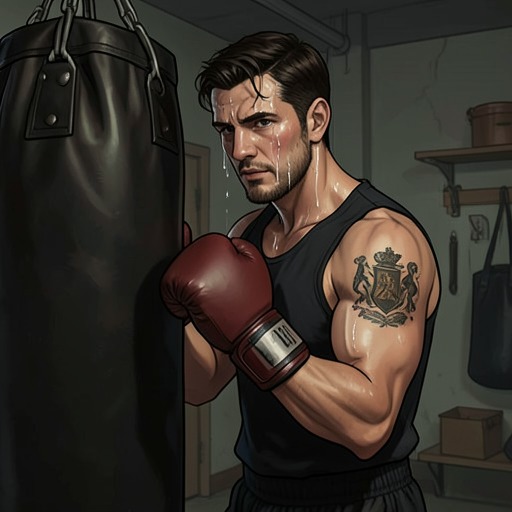
The discussion also identifies what did not follow the boxing years. Asked whether Hara boxed again after the earlier period in his life, Kido says that it seems he did not. Yanagisawa looks again at the photograph of Hara with Rié and mourns that he died young. The photograph becomes a point of contact between the absent man and the living people trying to make sense of his ending.
Forestry, Land, and Risk
Kido’s inquiry eventually takes him to a forestry site with Ito, the head of Ito Lumber. He explains that his interest in the industry grew while he was handling Rié’s affairs after the death of Daisuké Taniguchi. Though he has grown accustomed to thinking of the dead man as Hara, he knows that people in the area still knew him as Daisuké. The investigation therefore carries two kinds of attention at once: the circumstances of a worker’s death and the identities by which that worker was known.
Ito describes an industry shaped by ownership disputes and economic pressure. Ito Lumber logs national forests for which it purchases the rights, and its work is booked for two years. The business depends on government subsidies and competes with imported materials, though the growth of biomass generators has made wood saleable and the market reasonably sound. At the same time, declining interest in inheriting mountain land has multiplied claim holders and left some plots with uncertain ownership. Ito says that unscrupulous crews exploit the confusion by buying small adjoining plots and cutting trees where ownership is disputed. Family registers are sometimes consulted to trace owners, but the claims branch into a difficult tangle.
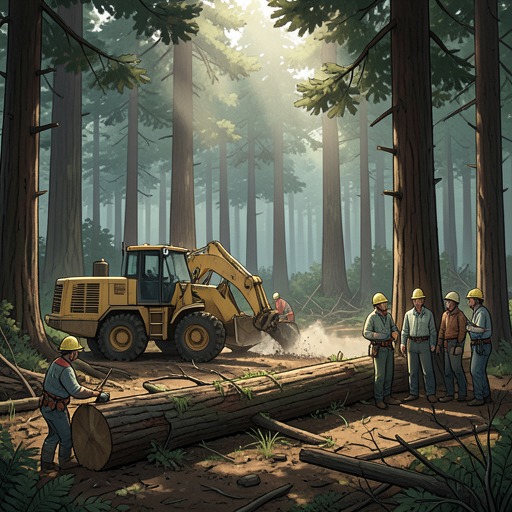
The account sets the accident within work governed by both physical danger and the conditions under which jobs are accepted. Ito says occupational accidents are common, including incidents involving logging and machines slipping off cliffs, as well as hazards from snakes and wasps. At the site Kido visits, a long-necked orange machine grips logs, lifts them, and strips away their branches; beyond the cut stumps, the terrain drops into a steep slope. The visit is not to the precise place where Hara died, Ito explains, but to a similar site nearby. The machinery has eased some physical demands, yet Ito cautions that forestry remains hard work, with heat and cold taking their toll.
Responsibility and Remorse
On the drive, Ito confesses that he continues to blame himself for what happened to Taniguchi-kun. He prays before the household altar every morning and says that, since taking over the company from his father, he had not witnessed a major accident before this one. The loss weighs especially heavily because this was the one time he accepted a site with poor conditions, for a client he felt unable to refuse. His account connects Hara’s death to a specific business decision without reducing the event to a simple explanation: Ito identifies the compromised conditions and his own choice, while also describing the broader frequency of danger in the trade.
The forest tour supplies a contrasting scale of time. Ito says trees are generally cut at about fifty years of age and may then serve another fifty years as building material. He describes each tree as having roughly a century of life: fifty years on the mountain, then fifty years with people. That long passage from forest to house stands beside the abruptness of Hara’s death. The work converts living trees into useful material across generations, but the human labor involved remains vulnerable to accidents that can end a life in a moment.
Memory and the Meaning of the Ending
Yanagisawa’s response to the photograph changes the conversation from the circumstances of death to the life that preceded it. He says that, although it is a shame Hara died so young, he is glad Hara was happy in the end. Kido agrees, saying he truly believes Hara was happy. The judgment is not offered as a denial of the loss; it is a way of holding the final years against the early troubles that the men remember.
Yanagisawa is especially glad that Hara made it to the finish line without hurting anyone, as he had always feared doing. He wishes he could tell Hara that he had been right, and adds that there are many other things he wishes he could say to him now; he thinks the president would feel the same. Kido still worries about the safety of Daisuké Taniguchi, but in that moment he accepts the truth in Yanagisawa’s words. The ending thus leaves grief unresolved while giving it a precise consolation: Hara’s death was premature and accidental, yet those who knew his fear believe he reached the end without inflicting the harm he dreaded.